A gear ratio is chainring teeth divided by sprocket teeth. A 50T chainring with an 11T sprocket is 4.55, so the wheel turns 4.55 times per pedal stroke; a 34T chainring with a 34T sprocket is 1.00, one wheel turn per pedal stroke. Everything else in gearing is a way of making that number useful: converting it to speed, comparing it between bikes, and deciding how many of those ratios you actually need.
This guide covers the calculation, the three ways riders compare gears, the range against steps trade-off that drives every crankset and cassette decision, and the part most gearing guides ignore: what your gear choice does to drivetrain efficiency and shifting quality.
Calculating a Gear Ratio and Reading the Number
The formula is one division: chainring teeth divided by sprocket teeth. A higher number is a harder, faster gear. A lower number is an easier, slower gear. That is the whole of it, and it holds for every bike ever built.
| Gear | Ratio | What it is for |
|---|---|---|
| 53×11 (standard chainset) | 4.82 | Top-end sprint and fast descent |
| 50×11 (compact chainset) | 4.55 | Highest gear on most modern road bikes |
| 50×17 | 2.94 | Typical cruising gear on the flat |
| 34×28 | 1.21 | Sustained climbing gear |
| 34×34 | 1.00 | The 1:1 climbing benchmark |
| 30×34 (sub-compact) | 0.88 | Steep gradients and loaded riding |
Two things follow from the table. First, the same ratio can be reached by different combinations: 50×25 and 34×17 are both very close to 2.00, which is why counting the number of sprockets on a cassette tells you nothing about how many usable gears you have. Second, the ratio says nothing about wheel size, which is where the next measurement comes in.
That first point is worth a moment. A 2×12 drivetrain is sold as 24 gears, but once you remove the duplicated ratios and the cross-chained combinations you would not use anyway, the number of genuinely distinct, usable gears is closer to 16 or 18. The useful question is not how many sprockets you have, it is how wide the span is between your easiest and hardest gear, and how evenly the steps are spread across it.
Gear Inches, Development and Gain Ratio
Ratios only compare two sprockets. To compare gearing between bikes, you have to include the wheel, because the same ratio on a 700x25c road wheel and a 700x45c gravel tyre does not travel the same distance.
Gear inches multiply the ratio by the wheel diameter in inches. It is the oldest of the three measures, inherited from penny farthing days when the gear literally was the wheel size, and it is still the most widely quoted. Low gearing sits around 20 to 30 gear inches, mid-range gearing around 70, and top-end gearing around 120 or more.
Development, also called roll-out, multiplies the ratio by the wheel circumference in metres. It answers the most tangible question of the three: how far does the bike travel for one turn of the cranks.
Gain ratio adds crank length to the equation, comparing how far the wheel travels against how far your foot travels. It is the most complete measure and the least used, but it is the one that explains why changing crank length changes how a gear feels without changing the ratio at all.
| Gear | Ratio | Gear inches | Development |
|---|---|---|---|
| 50×11 | 4.55 | 121.7 | 9.71 m |
| 50×17 | 2.94 | 78.7 | 6.28 m |
| 34×28 | 1.21 | 32.5 | 2.59 m |
| 34×34 | 1.00 | 26.8 | 2.14 m |
| 30×34 | 0.88 | 23.6 | 1.88 m |
Figures calculated for a 700x28c wheel and tyre, about 2136 mm of rolling circumference and 26.8 inches of diameter. Change the tyre size and every number moves slightly, which is exactly why the wheel has to be in the calculation. Wikipedia keeps a clear reference on gear inches and the wider maths of bicycle gearing if you want the derivations.
From Ratio to Speed: Cadence Does the Rest
A gear does not have a speed. A gear plus a cadence has a speed, and the conversion is simple: development in metres, multiplied by cadence in revolutions per minute, multiplied by 60, gives metres per hour.
| Gear | 70 rpm | 80 rpm | 90 rpm | 100 rpm |
|---|---|---|---|---|
| 50×11 | 40.8 km/h | 46.6 km/h | 52.4 km/h | 58.3 km/h |
| 50×17 | 26.4 km/h | 30.2 km/h | 33.9 km/h | 37.7 km/h |
| 34×28 | 10.9 km/h | 12.4 km/h | 14.0 km/h | 15.6 km/h |
| 34×34 | 9.0 km/h | 10.3 km/h | 11.5 km/h | 12.8 km/h |
| 30×34 | 7.9 km/h | 9.0 km/h | 10.2 km/h | 11.3 km/h |
The top of the table matters less than it looks. A 50×11 at 90 rpm is 52 km/h, a speed most riders reach only on a descent, where they are coasting rather than pedalling. Running out of top-end gear is rare. Running out of bottom-end gear happens on every steep climb, which is why modern road gearing has drifted steadily towards wider cassettes.
Range Against Steps: The Real Trade-Off
Every gearing decision is the same compromise. A wide range gives you an easier bottom gear, but spreading the same number of sprockets over a wider range means bigger jumps between them, and each jump forces a bigger cadence change when you shift.
| Setup | Lowest gear | Highest gear | Character |
|---|---|---|---|
| Standard 53/39 with 11-28 | 1.39 | 4.82 | Small steps, high top end, hard on climbs |
| Semi-compact 52/36 with 11-30 | 1.20 | 4.73 | The all-round road choice |
| Compact 50/34 with 11-32 | 1.06 | 4.55 | Suits most riders on most terrain |
| Compact 50/34 with 11-34 | 1.00 | 4.55 | 1:1 safety net, larger jumps |
| Sub-compact 46/30 with 11-34 | 0.88 | 4.18 | Steep gradients, gravel, loaded riding |
The pattern is clear: on the road, the top gear barely changes across all five setups, while the bottom gear changes a lot. You are not really choosing a top speed, you are choosing how hard your easiest gear will be, and how large the steps between gears end up.
1x against 2x is the same trade-off in a different form. Removing the front chainring removes the front shift entirely, which is why gravel and off-road bikes have adopted 1x so widely: nothing to mis-shift under load, less to maintain, a simpler chainline story. The price is bigger jumps, because one chainring has to cover the whole range through the cassette alone. On the road, where holding a cadence is the point, 2x still wins on step size. If you want the sprocket-by-sprocket detail, our bicycle cassette guide covers sizes, ranges and freehub compatibility.
Choosing Gears for the Terrain You Actually Ride
Start from your steepest regular climb, not from what a professional rides. Two rules cover most cases.
The 1:1 rule. If your smallest chainring has the same number of teeth as your largest sprocket or fewer, you have a 1:1 gear or better, which is roughly 11.5 km/h at 90 rpm. For most riders on most road gradients, that is enough. A 34T chainring with a 34T sprocket, or a 36T with a 36T, both get you there.
Go below 1:1 when the gradient or the load says so. Regular gradients above 10 to 12%, long alpine climbs at the end of a big day, bikepacking weight, or simply being a rider who prefers spinning to grinding, all point to a sub-compact chainset. A 30T chainring with a 34T sprocket gives 0.88, about 10 km/h at 90 rpm, and it costs you almost nothing at the top end you never use.
Time trial and triathlon reverse the priority. On a flat, sustained effort the useful gears sit in a narrow band around the target speed, so step size matters more than range. A close-ratio cassette keeps you within a couple of rpm of your target cadence when the gradient or the wind shifts slightly, instead of forcing a jump of 6 or 7 rpm. It is also the discipline where drivetrain friction is worth the most, because the effort never stops.
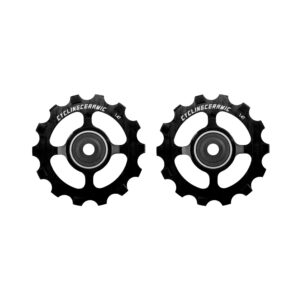
Gravel adds one more variable: the terrain is slower and more variable, so the useful range sits lower overall and the ability to shift under load matters more than the size of the steps. That is the reasoning behind gravel-specific cages, which are built around larger sprockets. Our Shimano GRX cage is rated for a maximum 36T double setup, and the SRAM Apex 1 gravel version handles up to a 42T sprocket.
Where Gearing Meets Drivetrain Efficiency
Gearing guides usually stop at the ratio. In practice, how you reach a ratio changes how much power you lose getting it to the road, and this is the part worth understanding before you buy anything.
Cross-chaining costs you watts. Big chainring with the biggest sprocket, or small chainring with the smallest, pushes the chain across an angle it was not designed to run at. The chain articulates sideways as well as around, friction rises, and both chain and sprockets wear faster. Two gears with the same ratio are not equally efficient: the one with the straighter chainline is. On a 2x drivetrain, that usually means shifting the front ring rather than reaching for the last two sprockets at either end.
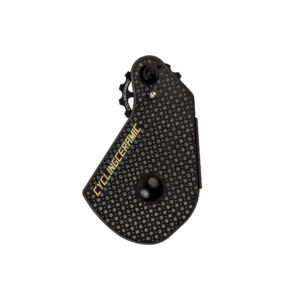
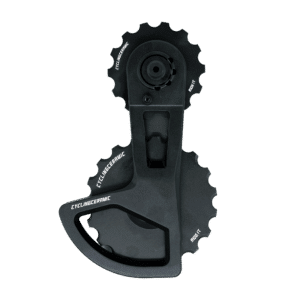
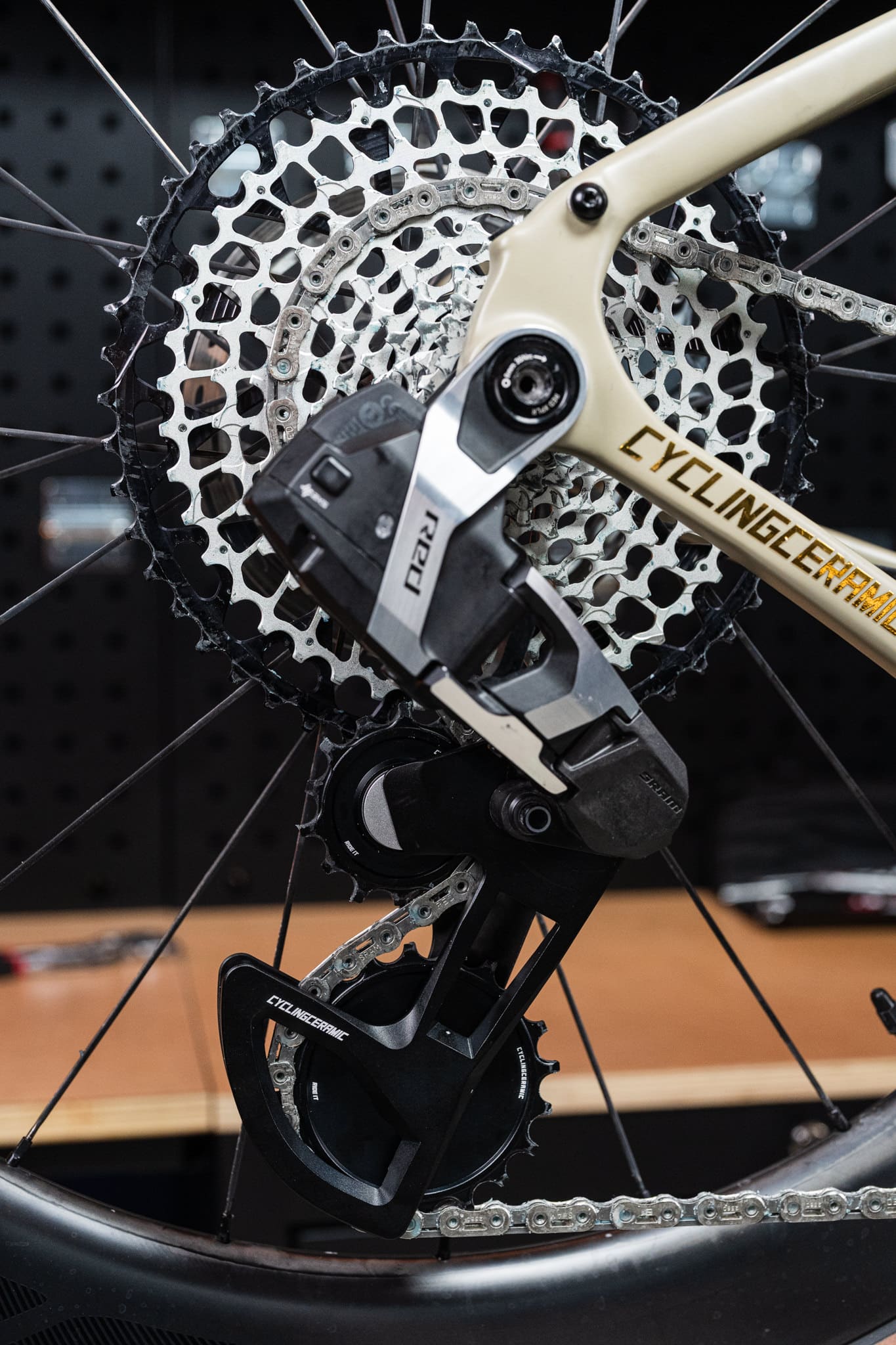
Pulley size changes the friction the derailleur adds. Every link of chain that goes around a small pulley wheel has to articulate through a tight angle, and that articulation is a loss. Larger pulleys reduce the angle, which is the mechanical argument behind oversized cages: a 14/19T pulley pairing replaces the standard 11/11T and cuts the friction the derailleur contributes.
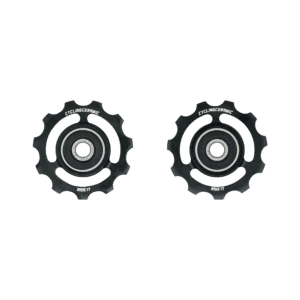
Pulley bearing quality is measurable. Friction Facts measured CyclingCeramic 11T pulley wheels at 0.039W against 1.175W for a standard Shimano Dura-Ace pulley, a 97% reduction, in a comparison covering 19 pulley models across Shimano, SRAM and Campagnolo. Full test data is on our test and lab data page.
There is a fit consideration too. An oversized cage changes chain wrap and chain tension, so it has to be matched to your derailleur and to your maximum sprocket size rather than chosen by looks. Our oversized derailleur cages are listed by groupset, speed count and usage for that reason, and the derailleur pulley support page covers setup and servicing.
Frequently Asked Questions
How do you calculate a bike gear ratio?
Divide the number of teeth on the chainring by the number of teeth on the rear sprocket. A 50T chainring with an 11T sprocket gives 50 divided by 11, which is 4.55, so the rear wheel turns 4.55 times for every full turn of the cranks. A 34T chainring with a 34T sprocket gives 1.00, one wheel turn per crank turn, which is the classic 1:1 climbing gear. Higher numbers mean more speed per pedal stroke and more force needed. Lower numbers mean the opposite.
What is the difference between gear ratio and gear inches?
Gear ratio only compares the two sprockets, so it ignores wheel size. Gear inches multiplies that ratio by the wheel diameter in inches, which makes gearing comparable between bikes with different wheels, a road bike and a gravel bike on larger tyres for example. On a 700x28c wheel, roughly 26.8 inches in diameter, a 50×11 works out at about 122 gear inches and a 34×34 at about 27. Gear development is the same idea in metres: how far the bike travels per crank revolution.
What gear ratio do I need for steep climbs?
A 1:1 ratio is the usual benchmark, meaning your smallest chainring has the same tooth count or fewer than your largest sprocket. A 34T chainring with a 34T sprocket gives exactly 1.00 and rolls at about 11.5 km/h at 90 rpm, which is enough for most riders on most road gradients. If you regularly ride above 10 to 12%, or you are carrying luggage, go below 1:1 with a sub-compact chainset, for example 30T against a 34T sprocket, which gives 0.88 and about 10 km/h at the same cadence.
Is a 1x or 2x drivetrain better?
It depends on whether you value simplicity or small steps between gears. A 1x drivetrain removes the front derailleur and the risk of a front shift going wrong, which suits gravel and off-road riding, but a single chainring across a wide cassette produces bigger jumps between gears. A 2x drivetrain keeps the steps small, which matters on the road where holding a steady cadence is the point, at the cost of a second shifter and more chainline compromises to manage. Neither is faster in itself.
Does gearing choice affect drivetrain efficiency?
Yes, in two ways. Cross-chaining, where you run the big chainring with the biggest sprocket or the small chainring with the smallest, forces the chain to run at an angle, which increases friction and wear, so the same ratio reached through a straighter chainline is more efficient. Second, pulley size and pulley bearing quality matter: larger oversized pulley wheels reduce the chain articulation angle, and Friction Facts measured CyclingCeramic 11T pulleys at 0.039W against 1.175W for a standard Shimano Dura-Ace unit, a 97% reduction.
Bottom Line
Gear ratios are one division, and once you convert them into development and then into speed at your own cadence, the whole gearing decision becomes concrete: what is the slowest speed I can climb at, and what gear holds my cadence there. For most road riders the answer is a compact chainset with a cassette large enough to reach 1:1, and for steep or loaded riding, something below it.
The part worth adding is what happens after the ratio is chosen. Keep the chainline straight, avoid living in the extreme sprockets, and remember that the derailleur itself is a friction source you can do something about. A 14/19T oversized aero cage or a full oversized pulley wheel system is worth around 3.3W of friction, while a straight swap to ceramic 11T pulley wheels takes 97% out of the pulleys themselves. For gravel, the GRX gravel cage and 14T pulley set are built around the larger sprockets those drivetrains use. All of them are made by hand in France on Grade 3 Si3N4 bearings with a 4-year warranty.
Products mentioned in this article