La cadena es el componente que requiere más mantenimiento en una bicicleta de carretera y, medida por gramo, una de las mejoras de mayor impacto disponibles. También es una de las que más se malinterpreta. La mayoría de los ciclistas saben que eventualmente deben reemplazarla y mantenerla lubricada de alguna manera, pero los detalles de cuándo, cómo y con qué marcan una diferencia mucho mayor en el rendimiento y la longevidad de lo que sugieren la mayoría de las guías de transmisión.
La diferencia entre una cadena mal mantenida con lubricante de aceite genérico y una cadena limpia tratada con cera es de aproximadamente 3 vatios, según pruebas de laboratorio internas. No es una ganancia marginal. Es el tipo de diferencia que se nota en una contrarreloj de 40 km o en una gran fondo de cinco horas, y está al alcance de cualquier ciclista dispuesto a replantearse cómo aborda el mantenimiento de la cadena.
Esta guía cubre el panorama completo: cómo se construyen las cadenas de bicicletas de carretera, cómo navegar la compatibilidad entre transmisiones de 11 y 12 velocidades, cómo medir el desgaste correctamente y cómo la elección de lubricación afecta tanto el rendimiento como la duración de toda su transmisión.
Cómo se construye la cadena de una bicicleta de carretera
Una cadena de bicicleta está construida con placas de eslabones interiores y exteriores alternadas, conectadas por pasadores, con rodillos situados entre las placas interiores en cada eslabón. Cuando la cadena se enrolla alrededor de un piñón, los rodillos se acoplan a los dientes del piñón —el rodillo gira contra el pasador mientras la cadena se dobla y se endereza, que es donde se genera la fricción y donde se acumula el desgaste con el tiempo.
Las cadenas de transmisión modernas son componentes de precisión. Una cadena de 12 velocidades de calidad tiene un ancho exterior de aproximadamente 5.25 mm y un ancho interior de alrededor de 2.18 mm, dimensiones precisas a fracciones de milímetro, diseñadas para encajar con las rampas y los pernos del piñón diseñados para guiar la cadena durante los cambios. Cuanto más ajustadas son las tolerancias de fabricación, más suaves son los cambios y menor es la fricción bajo carga.
Las elecciones de materiales varían en el mercado. Las cadenas de nivel de entrada utilizan placas exteriores de acero macizo en toda su extensión. Las cadenas de gama media y de alto rendimiento introducen níquelado en las placas exteriores, lo que mejora la resistencia a la corrosión y le da a la cadena un aspecto pulido que también reduce marginalmente la adherencia de la suciedad. Las cadenas de primer nivel presentan pasadores huecos (Reducir peso sin sacrificar la integridad estructural), bordes de placa achaflanados (mejorando el acoplamiento de la cadena con rampas de cambio), y en algunos casos tratamientos superficiales que alteran las características de fricción y desgaste del propio metal. CyclingCeramic Cadenas de competición llevar esto más allá con un proceso de optimización de nueve pasos aplicado en nuestro taller en Francia — un tratamiento que va más allá de la construcción base de la cadena para cambiar fundamentalmente su rendimiento.
Compatibilidad de cadenas: Igualar número de velocidades y marca
La regla de compatibilidad más importante para las cadenas de bicicletas de carretera es sencilla: Siempre ajusta tu cadena a la cantidad de velocidades de tu transmisión.. Una cadena de 12 velocidades es más estrecha que una cadena de 11 velocidades, que a su vez es más estrecha que una cadena de 10 velocidades. Montar el ancho incorrecto interrumpe el acoplamiento de la cadena con las rampas de los piñones y los pasadores de cambio, lo que resulta en un cambio deficiente, mayor fricción y un desgaste acelerado tanto de la cadena como del cassette.
A 10 y 11 velocidades, las principales marcas —Shimano, SRAM y Campagnolo— comparten suficiente similitud dimensional como para que las cadenas de diferentes marcas sean en gran medida funcionales dentro del mismo número de velocidades. Una cadena Shimano de 11 velocidades funciona aceptablemente en un cassette SRAM de 11 velocidades y viceversa. A 12 velocidades, esta compatibilidad cruzada desaparece. Cada marca ha optimizado la geometría de su cadena para que funcione específicamente con su propio perfil de rampa y pasador de cassette de 12 velocidades. No se recomienda usar una cadena Shimano de 12 velocidades en un grupo SRAM AXS, o una cadena SRAM en un cassette Shimano de 12 velocidades, y esto comprometerá la calidad del cambio.
La siguiente tabla resume las relaciones de compatibilidad clave entre las transmisiones actuales de carretera:
| Velocidad | Cadena Shimano | Cadena SRAM | Cadena Campagnolo | ¿Compatible entre sí? |
|---|---|---|---|---|
| 10 velocidades | HG-X | PC-1030 | Graba 10s | Sí (dentro de la velocidad) |
| 11 velocidades | HG-X11 | PC-1110 | Disco 11s | Generalmente sí |
| 12 velocidades ruta | CN-M9100 | Pelo corto en la parte superior | Grabar 12s | No — específico de la marca |
Las cadenas CyclingCeramic Race están disponibles en Variantes de 11 y 12 velocidades, compatible con grupos Shimano, SRAM y Campagnolo dentro de cada rango de velocidad. Cada cadena viene pretratada y lista para instalar; no se requiere desengrasado ni aplicación inicial de cera.
Entendimiento y Medición del Desgaste de la Cadena
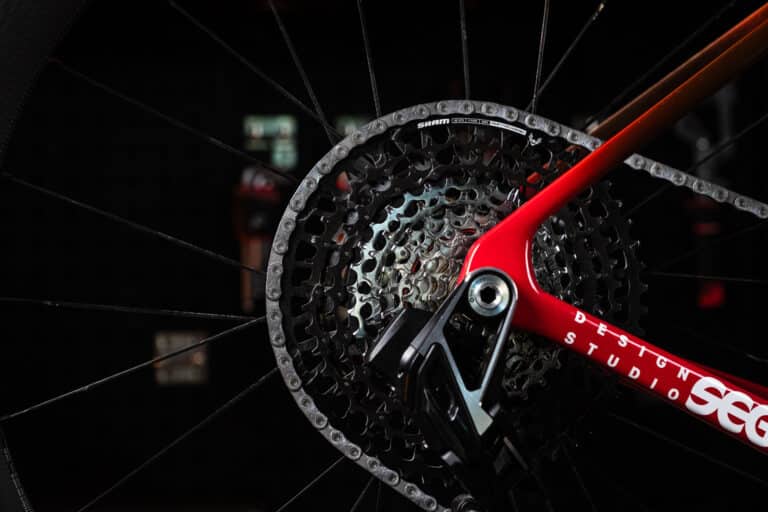
Las cadenas no se desgastan perdiendo material de las placas exteriores. Se desgastan alargándose: los pasadores y los orificios de los eslabones interiores se erosionan gradualmente bajo carga, y el efecto acumulativo de miles de pequeñas holguras que se abren resulta en una cadena que se asienta más afuera en los dientes del cassette de lo que fue diseñada. Cuando una cadena desgastada se acopla con dientes de piñón con los que ya no coincide geométricamente, los dientes soportan la carga en sus puntas en lugar de en sus flancos, que es lo que causa el característico perfil de aleta de tiburón de un cassette desgastado y el salto de cadena bajo carga que indica una transmisión que necesita ser reemplazada urgentemente.
El desgaste de la cadena se mide como un porcentaje de alargamiento con respecto al espaciado nominal de los eslabones interiores de 12 pulgadas (304,8 mm). Los dos umbrales clave que necesita conocer son diferentes para las transmisiones modernas que las cifras que puede haber aprendido en bicicletas antiguas. Para Cadenas de 11 y 12 velocidades, reemplazar en 0.5% elongación. El umbral anterior de 0.75% era apropiado para las cadenas más anchas y tolerantes de las transmisiones de 8 y 9 velocidades; a 12 velocidades, continuar más allá de 0.5% es una forma segura de arruinar un casete. Una simple herramienta medidora de desgaste de cadena cuesta muy poco y se tarda diez segundos en usarla. Comprueba tu cadena cada 500 km.

Tipos de lubricación y lo que los datos realmente muestran
La lubricación de la cadena es donde las afirmaciones de marketing divergen más drásticamente del rendimiento medido. La mayoría de los ciclistas eligen un lubricante basándose en el hábito, la disponibilidad o el reconocimiento de la marca, pero las pruebas de laboratorio independientes cuentan una historia diferente sobre qué enfoque realmente reduce la fricción y prolonga la vida útil de la transmisión.
Lubricantes húmedos son productos a base de aceite diseñados para permanecer en la cadena bajo condiciones húmedas y fangosas. Son muy duraderos y no se lavan fácilmente, lo que los convierte en la opción adecuada para recorridos prolongados en climas húmedos, ciclocross o recorridos sostenidos bajo la lluvia donde la reaplicación frecuente no es práctica. La desventaja es que el aceite atrae y retiene la suciedad de la carretera, formando una pasta abrasiva dentro de las interfaces de pernos y rodillos de la cadena. Esto es lo que impulsa el desgaste acelerado asociado con las cadenas lubricadas con aceite en condiciones contaminadas.
Lubricantes secos son típicamente productos a base de cera o PTFE diseñados para penetrar la cadena y luego secarse en una película que repele la suciedad. Producen una transmisión más limpia que los aceites húmedos en condiciones secas, pero ofrecen una protección limitada en lluvia sostenida y generalmente requieren una reaplicación más frecuente.
Tratamientos de cera — ya sea cera líquida aplicada a una cadena despojada, o inmersión en cera caliente — representan la óptima de rendimiento actual, y los datos de prueba son inequívocos. Pruebas internas de laboratorio que miden la fricción de la cadena entre tipos de lubricantes mostraron una brecha consistente de aproximadamente 3 vatios entre una cadena lubricada con aceite estándar y una cadena tratada adecuadamente con cera. Esa cifra se mantiene en condiciones de carretera y grava.
Resultados de pruebas de laboratorio: ¿Cuánto importa realmente la elección de la cadena?
CyclingCeramic sometió su cadena Race Chain a pruebas de laboratorio independientes para compararla con una cadena Shimano estándar con lubricante de aceite en condiciones controladas. La prueba se realizó a potencia y velocidad estandarizadas, aislando la fricción de la cadena como la única variable. Los resultados fueron directos:
| Configuración de cadena | Fricción (Vatios) | Diferencia |
|---|---|---|
| Cadena Shimano — lubricante de aceite estándar | 6.5W | — |
| Race Chain de CyclingCeramic — encerado | 3,6W | −2.9W (~3W) |
La contribución de la cadena se enmarca en un panorama de transmisión más amplio. Una transmisión completa equipada con CyclingCeramic -cadena de competición, roldanas cerámicas, pedalier cerámico y rodamientos cerámicos de rueda- ahorra aproximadamente 10 vatios total frente a una configuración de acero estándar en todos los puntos de fricción. La cadena representa la mayor parte individual de esos ahorros. Para el desglose completo de la prueba en todos los componentes, consulte nuestra Página de Pruebas y Datos.
Cómo se fabrica la cadena CyclingCeramic Race
Una cadena encerada no es simplemente una cadena estándar a la que se le vierte cera. El proceso importa, y acortarlo —aplicar lubricante de cera líquido a una cadena que aún tiene contaminación de aceite de fábrica— produce malos resultados porque la cera no puede penetrar en los rodillos debidamente lubricados y simplemente se asienta en la superficie donde ofrece poco beneficio.
La cadena Race de CyclingCeramic pasa por un tratamiento de taller de nueve pasos en nuestras instalaciones en Francia. El proceso comienza con un ciclo de limpieza de precisión que elimina todos los lubricantes de fábrica y contaminantes de la cadena, seguido de una limpieza ultrasónica para preparar las superficies internas a nivel microscópico. Luego, la cadena se somete a una inmersión en cera caliente —inmersión total en cera fundida a temperatura controlada— que fuerza la cera en cada unión de pasador, rodillo y placa interior. Después del enfriamiento controlado y la preparación de la superficie, la cadena se inspecciona y se empaqueta lista para su instalación.
El resultado es una cadena que llega a tu puerta en las mismas condiciones que una cadena que ha pasado por una preparación profesional pre-carrera en un taller. La instalas directamente en tu bicicleta sin ningún paso adicional de limpieza o lubricación. Cuando el tratamiento de cera inicial comienza a desgastarse —típicamente después de 300-500 km en condiciones secas, identificado por ruido de la cadena o descamación visible de la cera—, debes volver a aplicar utilizando Cera para cadena de bicicleta, cera líquida o cera caliente, manteniendo las mismas propiedades de fricción en cada aplicación posterior.
Cómo elegir la cadena adecuada para tu bicicleta de carretera
Para la mayoría de los ciclistas de carretera, la elección se reduce a dos preguntas: ¿qué cuenta de velocidad coincide con tu transmisión y cuánto quieres optimizar el rendimiento frente a la conveniencia?
Si tu prioridad es mantener la bicicleta en funcionamiento con una mínima atención al ritual de mantenimiento, una cadena OEM de calidad con un lubricante para mojado o seco y un hábito constante de comprobación del desgaste te servirá adecuadamente. Utiliza un indicador de desgaste de cadena cada 500 km, reemplaza a 0.5%, y tu cassette durará a través de múltiples reemplazos de cadena.
Si buscas ganancias de rendimiento medibles — ya sea para carreras, eventos de larga distancia o simplemente para que tu bicicleta funcione de la mejor manera — una cadena tratada con cera es el cambio único de mayor impacto que puedes hacer en tu transmisión. El ahorro de 3W documentado en pruebas de laboratorio es real, repetible y está disponible independientemente de tu nivel de condición física o gama de equipamiento. Una cadena de cera en un grupo de gama media supera a una cadena lubricada con aceite en un grupo de gama alta. Los vatios no se preocupan por el nombre de la marca en tu casete.
Para los ciclistas que desean el rendimiento de una cadena tratada con cera sin tener que realizar el proceso de retirada y reacondicionamiento en casa, Cadenas Ceramic Speed Race la solución lista para instalar — disponible en 11 y 12 velocidades, compatible con Shimano, SRAM y Campagnolo, y pretratada en Francia con un estándar de competición. Si ya usas una cadena estándar y quieres pasarte a la cera en tu próxima sustitución, nuestra cadena encerada vs cadena engrasada cubre el proceso completo de comparación y transición en detalle.
Preguntas frecuentes
¿Con qué frecuencia debo reemplazar la cadena de mi bicicleta de carretera?
Reemplace su cadena cuando un indicador de desgaste de la cadena marque una elongación de 0.5%en una transmisión de 11 o 12 velocidades — no 0.75%, que es el umbral antiguo de las cadenas más anchas de 8 y 9 velocidades. Las cadenas modernas más estrechas son más sensibles al desgaste, y usarlas hasta una elongación de 0.75% normalmente significa que los dientes de su cassette ya están dañados. La rapidez con la que alcance ese umbral depende en gran medida de la lubricación: una cadena lubricada con aceite utilizada en condiciones típicas de carretera puede necesitar ser reemplazada después de 1,500–2,500 km. Una cadena tratada con cera en condiciones equivalentes a menudo puede durar de 3,000 a 5,000 km antes de alcanzar el mismo punto de desgaste.
¿Puedo usar una cadena de 11 velocidades en una transmisión de 12 velocidades?
No. Una cadena de 12 velocidades es más estrecha que una cadena de 11 velocidades, diseñada para adaptarse al espaciado más ajustado del casete de 12 velocidades. El uso de una cadena de 11 velocidades en un casete de 12 velocidades resultará en un mal cambio, mayor fricción y un desgaste acelerado tanto de la cadena como de los dientes del casete. Siempre haga coincidir el número de velocidades de su cadena con su transmisión. Las cadenas Shimano, SRAM y Campagnolo tampoco son intercambiables a 12 velocidades; la cadena de cada marca está optimizada para la geometría específica de rampa y pasador de su propio casete.
¿Cuál es el mejor lubricante para la cadena de una bicicleta de carretera?
Desde el punto de vista de la pura fricción y la longevidad de la transmisión, la cera es el mejor lubricante para la cadena de una bicicleta de carretera. Las pruebas de laboratorio internas muestran que una cadena tratada con cera ahorra aproximadamente 3 vatios en comparación con la misma cadena con un lubricante de aceite estándar, una diferencia de rendimiento medible. La cera también mantiene la transmisión significativamente más limpia que el aceite, ya que no atrae ni retiene la suciedad de la carretera. Los lubricantes de aceite húmedo tienen su lugar en condiciones sostenidas de humedad y barro donde la reaplicación frecuente no es práctica, pero para la conducción típica en carretera y grava seca, la cera es la opción óptima en rendimiento.
¿Cómo sé cuándo mi cadena necesita lubricación?
El indicador más confiable es audible: una cadena seca, que hace "tic-tac" o chirría bajo carga, te está diciendo que necesita lubricación. En una cadena tratada con cera, también puedes notar que la cera comienza a desprenderse al flexionar la cadena con la mano, lo que indica que es hora de volver a aplicarla. No esperes a que aparezca el ruido antes de lubricar; una vez que la cadena funciona en seco, la fricción y el desgaste ya están elevados. Como referencia, un tratamiento de cera líquida CyclingCeramic dura aproximadamente 300 km en condiciones secas antes de recomendar su reaplicación.
¿Las cadenas con recubrimiento cerámico valen la pena?
Sí, cuando el recubrimiento forma parte de un proceso de tratamiento integral en lugar de un acabado superficial. Las cadenas CyclingCeramic Race Chains pasan por un tratamiento de taller de nueve pasos en Francia —incluyendo limpieza de precisión, optimización de la superficie cerámica y una inmersión en cera caliente— que transforma una cadena estándar en un componente de transmisión listo para la competición. Las pruebas de laboratorio internas midieron el resultado en una pérdida de fricción de 3,6 W frente a los 6,5 W de una cadena Shimano estándar con lubricante de aceite: un ahorro de aproximadamente 3 vatios. Esa cifra es consistente en uso en carretera, grava y triatlón.
Conclusión
La cadena de la bicicleta de carretera es la pieza que se reemplaza con más frecuencia en tu transmisión y, cuando se elige y se mantiene correctamente, es una de las más impactantes. Para hacerlo bien se requieren tres cosas: igualar el número de velocidades y la marca con tu grupo, medir el desgaste en el umbral correcto de 0.5% en lugar de la cifra desactualizada de 0.75%, y elegir un enfoque de lubricación que realmente reduzca la fricción en lugar de simplemente evitar que la cadena funcione en seco.
Los datos de rendimiento no dejan lugar a dudas: una cadena tratada con cera ahorra aproximadamente 3 vatios en comparación con una cadena lubricada con aceite estándar en condiciones de prueba de laboratorio, una cifra que se traduce en ahorros de tiempo reales en cualquier contexto competitivo o de rendimiento. Combinado con la mayor vida útil del cassette que proporciona una transmisión limpia con cera, el argumento para alejarse del lubricante de aceite es tanto un argumento de rendimiento como un argumento de mantenimiento a largo plazo.
Ya sea que comiences con un Race Chain de CyclingCeramic como su próximo reemplazo, o transfiera su cadena existente a cera utilizando nuestro cera líquida o cera caliente productos, el principio es el mismo: la cadena más limpia y con menor fricción que puedas usar es la que causa menos daño a todo lo que toca, y el mayor impacto en tu rendimiento en la carretera.

Escrito por
Ilan
Consultor SEO — La Refonte
Consultor SEO y estratega de contenido responsable de la estrategia de crecimiento orgánico de CyclingCeramic. Cada artículo se basa en datos de pruebas de Friction Facts y en experiencia ciclista del mundo real.