¿Qué tamaño de poleas necesitas? Compatibilidad por grupo

El tamaño de la polea lo dicta tu cambio trasero, No solo por la velocidad de tu cassette ni por el número de velocidades. Cada fabricante diseña la carcasa en función de un número específico de dientes, y ese número de dientes es el que debes elegir. La tabla siguiente enumera los tamaños de reemplazo confirmados de CyclingCeramic para los gruposet de carretera y gravel actuales, escritos como superior/inferior.
| Grupo | Tamaño de polea (superior / inferior) |
|---|---|
| Shimano Dura-Ace R9100 (11 velocidades) | 11T / 11T |
| Shimano Dura-Ace R9200 (12 velocidades) | 11T / 11T |
| Shimano Ultegra R8000 / R8100 (velocidad de 11 y 12 velocidades) | 11T / 11T |
| Shimano GRX y XTR (de 11 y 12 velocidades para gravel y MTB) | 14T / 14T |
| SRAM Red / Force AXS (12 velocidades, primera generación) | 12T / 12T |
| SRAM RED E1 (última versión de 12 velocidades) | 12T / 14T |
| SRAM Red XPLR AXS (de 13 velocidades para gravel) / EAGLE T-TYPE | 14T / 16T |
| SRAM XPLR (de 12 velocidades) / Eagle MTB | 14T / 14T |
| Campagnolo Record / Chorus (de 11 velocidades) | 11T / 11T |
| Campagnolo Super Record y 12 velocidades | 12T / 12T |
| Campagnolo Super Record Wireless (de 13 velocidades) | Conjunto 14T |
| Campagnolo EKAR (de 13 velocidades para gravel) | 12T / 14T |
Tres patrones destacan: los desviadores de carretera de Shimano utilizan siempre un par de bielas idénticas. 11T / 11T ruedas de polea en las generaciones de carretera de 11 y 12 velocidades, mientras que los modelos de carretera y MTB de Shimano (GRX, XTR) avanzan hasta 14T. El AXS de carretera de SRAM de primera generación utiliza 12T / 12T, Pero el hardware más nuevo, SRAM RED E1 y el XPLR de 13 velocidades, adoptan tamaños divididos. Campagnolo ofrece la gama más amplia, desde 11T en el clásico Record hasta el XPLR de 13 velocidades en el 12T / 14T, Por eso es importante la notación superior/inferior. Para identificar tu grupo, busca el código del modelo impreso en la cártera del desviador trasero, como R9100, R8000, el nombre del modelo de SRAM o la designación E1 / XPLR. gama completa de poleas cerámicas está organizada por estos códigos de grupo para que selecciones el juego exactamente compatible.
Polea superior vs inferior: qué significa la notación del número de dientes
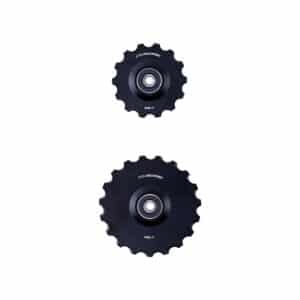
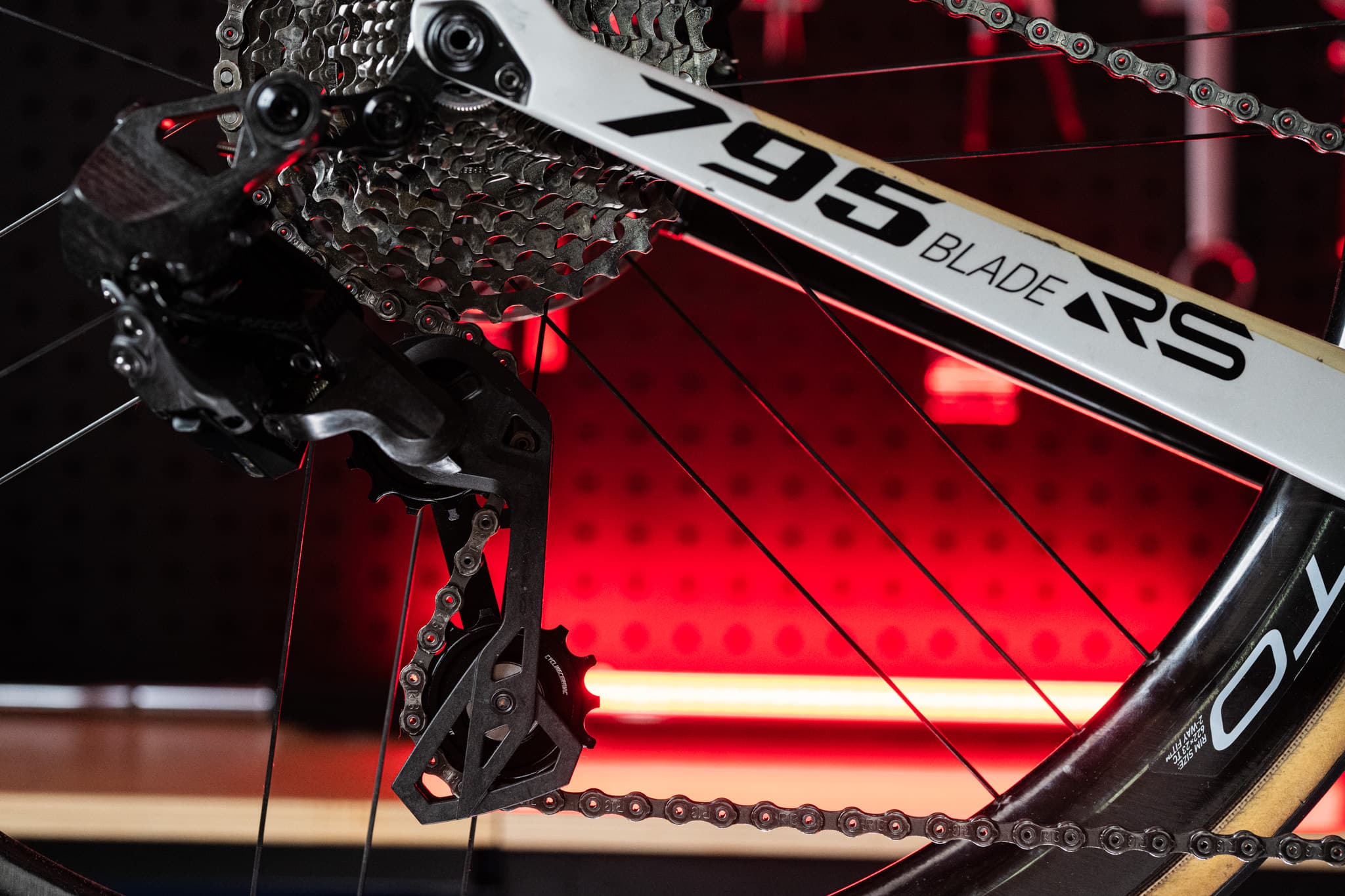
Un cambio trasero lleva dos poleas de cambio, y hacen trabajos distintos. Leer el tamaño como un par, superior y luego inferior, te dice exactamente qué pedir. La polea superior es la polea guía. Es la más cercana al casete y a veces está marcada con una G. Su función es dirigir lateralmente la cadena hacia el piñón correcto durante un cambio. Para hacerlo limpiamente se fabrica con un pequeño juego de lado a lado, por lo que las poleas guía y tensora no siempre son idénticas incluso dentro del mismo cambio. La polea inferior es la polea tensora. Se encuentra en la parte inferior del baúl y mantiene la cadena bajo una tensión constante a medida que el cambio de velocidad se estira a lo largo de toda la gama de marchas. Se desplaza en una línea más recta y da prioridad a una menor fricción en detrimento de la orientación lateral. Cuando se escribe un tamaño como 11T / 11T, ambas poleas llevan once dientes. Cuando se anota como 12T / 14T, Al igual que en los modelos Campagnolo EKAR y SRAM RED E1, la polea de guía superior tiene doce dientes y la polea de tensión inferior tiene catorce. La SRAM Red XPLR de 13 velocidades va aún más allá, combinando una polea superior de 14T con una inferior de 16T. Ajustar bien la relación es fundamental: colocar la polea más grande en la posición superior de la guía o viceversa, provoca un desajuste en el arrollamiento de la cadena y en la transmisión.
Por qué importa el tamaño de la polea: enrollado de cadena, tensión y cambio
El número de dientes no es cosmético. El tamaño de polea en torno al cual se diseñó tu cambio gobierna tres cosas que afectan directamente al funcionamiento de tu transmisión. Enrollado de cadena. El número de dientes y la posición de la polea guía determinan cuánta cadena engrana el casete y cómo se articula la cadena a través de la jaula. Una polea con el número de dientes equivocado cambia el ángulo de enrollado y puede dejar la cadena mal asentada. Tensión de cadena. La polea tensora inferior mantiene la cadena tensa en todas las marchas. Si el diámetro de la polea es incorrecto para la jaula, la tensión queda o demasiado floja, con riesgo de que la cadena se salga, o demasiado tensa, añadiendo arrastre. Calidad del cambio. La polea de guía superior posiciona la cadena para cada cambio de marcha. La cantidad correcta de dientes mantiene la coherencia del acoplamiento de las piezas, por lo que los cambios de marcha se mantienen rápidos y precisos. Las consecuencias mecánicas generales de utilizar una polea de tamaño incorrecto están bien documentadas: cambios de marcha hesitantes o ruidosos, desgaste acelerado de la cadena y la polea, y en casos extremos una cadena que se desprende de la carcasa. Ninguno de estos problemas es específico de CyclingCeramic; son el resultado estándar de una polea inadecuada en cualquier desviador. Esto también es la razón por la que la cantidad correcta de dientes es la condición previa para que la eficiencia se traduzca en un funcionamiento limpio. Los análisis independientes de Friction Facts registraron que las poleas CyclingCeramic de 11T tenían una fricción de 0,039 W, frente a 1,175 W para una pareja de Shimano Dura-Ace de stock, una reducción del 97%; la explicación completa se encuentra en nuestro comparativa de poleas de cerámica vs aluminio.
Poleas de recambio estándar vs jaula sobredimensionada
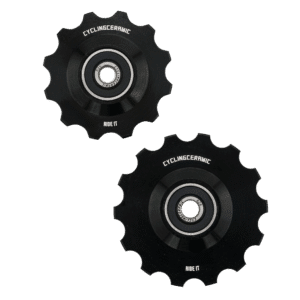
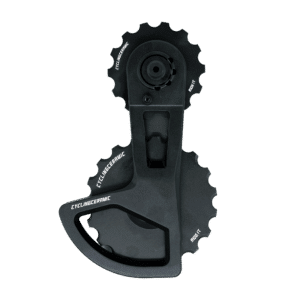
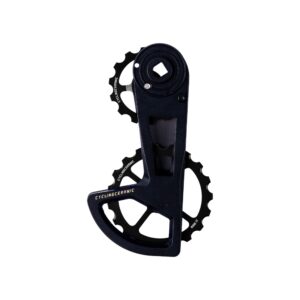
Uno de los puntos de confusión más comunes es mezclar dos productos diferentes. No son la misma compra, y elegir entre ellos cambia qué tamaños se aplican. Poleas de recambio estándar Son intercambios directos para las poleas que venían con tu desviador. Conservan la misma cantidad de dientes originales, por ejemplo 11T / 11T en las ruedas de carretera Shimano o 12T / 14T en la SRAM RED E1, y se pueden adaptar a la caja de cambio original. Es lo que necesitas si tu objetivo es mejorar la calidad de los rodamientos, restaurar poleas gastadas o mejorar la sensación de cambio sin cambiar la geometría del desviador. Cada tamaño de la tabla de compatibilidad anterior se refiere a estos reemplazos estándar. Sistemas de jaulas de tamaño extra grande (OSPW) Son un producto independiente que reemplaza toda la caja del desvío junto con poleas más grandes. Los contenedores de cerámica de tamaño grande suelen funcionar con 14/19T Diseño, con versiones específicas diseñadas para carretera, grava (incluyendo Shimano GRX / GRX Di2) y SRAM AXS. Las poleas más grandes reducen el ángulo de articulación de la cadena y reducen la fricción adicional, pero debido a que cambian la geometría de la carcasa, no son una sustitución estándar, sino un ajuste diferente.
| Aspecto | Pulleys de reemplazo estándar | Sistema de jaulas de gran tamaño (OSPW) |
|---|---|---|
| Qué sustituye | Solo las poleas de cambio | Jaula del cambio completa + poleas |
| Número de dientes | Tamaño de los neumáticos (por ejemplo: 11T / 11T, 12T / 14T) | De tamaño extra grande, normalmente de 14/19T |
| Montaje | Cambio directo | Nueva jaula, cambia la geometría |
| Ajuste del cambio | Revisión de tensión B aconsejable | Ajuste completo de tensión B + topes |
| Ideal para | Mejora de rodamientos, equivalente | Máxima reducción de fricción |
Si simplemente quieres poleas mejores y más duraderas para tu configuración actual, el recambio estándar en el tamaño de tu grupo es la elección correcta. La jaula sobredimensionada es una mejora aparte, más laboriosa, para ciclistas que persiguen la última fracción de vatio.
Cómo encajan las poleas de cambio de CyclingCeramic
Cada rueda de polea de CyclingCeramic está construida con el número de dientes correcto para su grupo objetivo, por lo que los tamaños de la tabla anterior son sustituciones exactas, no aproximaciones. El rango abarca toda la gama de transmisiones modernas: 11T para Shimano Road y Campagnolo Classic, 12T para SRAM AXS y Campagnolo de 12 velocidades, 12/14T para Campagnolo EKAR y SRAM RED E1, 14T para Shimano GRX/XTR y SRAM XPLR/MTB, un juego específico de 14/16T para SRAM XPLR de 13 velocidades y un juego de 14T para Campagnolo Super Record de 13 velocidades. Los cuerpos están mecanizados y fabricados con nitruro de silicio de grado 3 (Si3N4), el grado de cerámica más fino disponible, y toda la gama está hecho a mano en Francia y respaldada por una garantía de 4 años, Esto está muy por encima del promedio de la cobertura de un año para los componentes de los vehículos. Para una sustitución equivalente, la instalación suele ser una sustitución directa: retire los tornillos originales de la polea, transfiera las nuevas poleas a las posiciones superiores e inferiores correctas y vuelva a montar las poleas. Debido a que la orientación de las poleas y la tensión B afectan al cambio de marcha, es recomendable comprobar la tensión de la tornillería B después, y es imprescindible hacerlo si cambia a una caja de cambios más grande. Las instrucciones paso a paso y la guía específica para cada grupo están disponibles en página de soporte de poleas. Una nota sobre el hardware más reciente. Para los grupos electrónicos de 12 y 13 velocidades más nuevos, incluidos los SRAM RED E1, SRAM Red XPLR AXS de 13 velocidades, Campagnolo Super Record Wireless y el actual inalámbrico Shimano Di2, la colocación de las poleas varía de los modelos anteriores. En lugar de asumir un tamaño, consulte el selector de compatibilidad en el página de producto de poleas de cambio o contacta con el equipo a través de la página de soporte de poleas para una coincidencia confirmada.
Preguntas frecuentes
¿Qué tamaño de poleas de cambio necesito para Shimano?
¿Qué tamaño de poleas de cambio necesito para SRAM?
¿Son intercambiables las poleas de Shimano y SRAM?
¿Cuál es la diferencia entre la polea superior y la inferior?
¿Qué tamaño de ruedas de polea necesito para la SRAM Red XPLR de 13 velocidades?
¿Hay que ajustar el cambio después de montar poleas nuevas?
Conclusión
La elección del tamaño correcto de la polea depende de una sola regla y de una sola tabla. La regla: combinar la marca y la generación exacta de tu desviador trasero; nunca mezclar Shimano, SRAM y Campagnolo. La tabla: la mayoría de los grupos de carretera Shimano son compatibles 11T / 11T, Las primeras generaciones de SRAM Red y Force AXS están disponibles 12T / 12T, SRAM RED E1 toma 12T / 14T, La SRAM Red XPLR de 13 velocidades 14T / 16T, El Campagnolo Record tiene ejes de 11T/11T y el Campagnolo EKAR de 12T/14T. Lee la referencia como superior/inferior para confirmar si quieres un cambio estándar equivalente o un sistema de casete separado de tamaño extra (normalmente de 14/19T), y una adaptación equivalente suele ser una sustitución directa con un control rápido de la tensión de los rodamientos. Cuando la referencia coincide, una polea de calidad ofrece todo lo que sus rodamientos prometen; si no es así, incluso el mejor rodamiento se desplazará mal. Encuentra tu grupo exacto en la gama de poleas de cambio de CyclingCeramic, Y si estás utilizando el grupo electrónico más reciente, SRAM RED E1, XPLR de 13 velocidades o Campagnolo de 13 velocidades, página de soporte de poleas te orientará hacia el juego correcto. Para entender qué aporta realmente la mejora a la eficiencia de la transmisión una vez montada, la comparativa cerámica vs aluminio cubre los datos de laboratorio en detalle.
Productos mencionados en este artículo